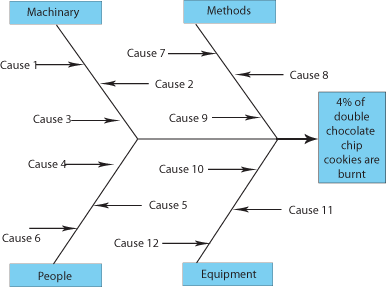
The cause and effect diagram is used to identify and discover all the potential or real causes (or inputs) that will lead to or result in a single effect (or output). The arrangement of the causes is done according to their level of importance or detail which results in a depiction of relationships and hierarchy of events.
It helps in finding the root causes, identifying the problematic areas and comparing the relative importance of different causes. It is also used to the organization diagramming, parts hierarchies, project planning, tree diagrams, and the 5 Why’s.
The C&E diagram is also famous as the fishbone diagram because it resembles the skeleton of a fish, with the main causes categories drawn as “bones” attached to the spine of the fish.
Chi-square test
A chi-square test (also chi-squared or ?2 test) is any statistical hypothesis test used to compare observed data with data we would expect to obtain according to a specific hypothesis and in which the sampling distribution of the test statistic is a chi-square distribution when the null hypothesis is true.
Chi-square test practices null hypothesis, which states that there is no significant difference between the expected and observed result in an event.
Some examples of chi-squared tests are Pearson’s chi-square test, Yates’ chi-square test, Mantel-Haenszel chi-square test, Linear-by-linear association chi-square test, The portmanteau test in time-series analysis, testing for the presence of autocorrelation.
Control Charts
The control chart, also known as the Shewhart chart or process-behaviour chart, is a tool used in statistical process control for determining whether a business process is in a state of statistical control or not. It is also known as a special-cause variation.
All points will be plotted within the control limits in case the process is in control,. Any observations outside the limits suggests the introduction of a source of variation which is new and unanticipated.
As increased variation means increased quality costs, a control chart revealing the presence of a special-cause calls for immediate investigation. Thus the control limits are a crucial decision aids. The control limits suggests about process behaviour .
Download :
 Six sigma tools are the Quality Management techniques, approaches and methodologies used in Six Sigma for the process improvement in an organization. Appropriate implementation of these tools brings about amazing results.
 Every organization needs to innovate itself times and again to survive and consistently perform in the competitive environment. Innovation is something new and contrary to established manners or practices. A new idea has to overcome a lot of resistance to become a reality.
 Six sigma metrics comprises of the different types of measurements that are applied in six sigma methodology. Getting the right measurement through the use of Six Sigma Metrics requires the application of these metrics in the right context. Innovative ways are needed to resolve the customer’s issues and improve the quality of the products.
 A Six Sigma metric is a standard measure for assessing the project performance in a particular area. Metrics are applied rigorously in any customer-focused process management system and any program targeted at continuous improvement.
 Process mapping is a renowned technique for the creation of a common vision and shared language which leads to the improvements in business results. It is usually the first step in the implementation of Six Sigma project. Process Maps and Flow Charts displays the activities in a process in a sequential manner.
 Six Sigma apples a wide variety of statistics for the determination of best practices for deployment of Six Sigma projects. Statisticians and Six Sigma consultants devise new methods which are based on the studies and experimentations of existed processes.
 Basically there are three classes of software used for the implementation of Six Sigma methodology.
 Case Study is defined as research strategy, which investigates the phenomenon with in real life scenario. It may include single and multiple case studies. It involves quantitative and qualitative evidence relying on multiple sources and benefits from prior developments.